
Download Our App
Shop your way




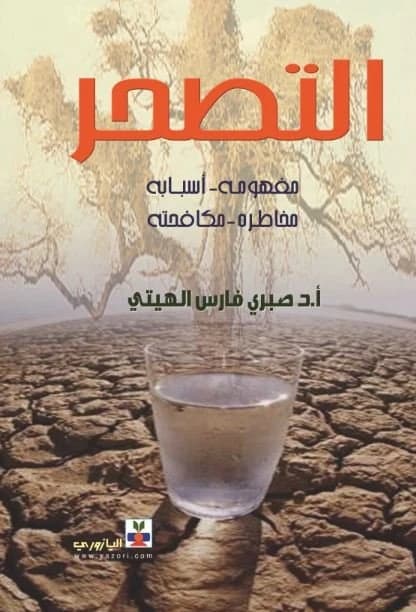
Desertification (Concept - Causes - Risks - Combating It) by Prof. Dr. Sabri Faris Al-Hiti
JOD

Get it by 5 Aug | Order in 3 Hours 33 Minutes
- Return Policy
- Warranty Policy
- Shipping Policy
- Non contact delivery
- Personal Receipt
- Return Policy
- Warranty Policy
- Shipping Policy
- Non contact delivery
- Personal Receipt
The issue of desertification is of great significance due to the problems it causes, affecting many aspects of human life on Earth. Interest in the topic first began when the United Nations General Assembly issued two resolutions in December 1974: the first calling on all nations to pay attention to desertification studies and cooperate in investigating its phenomena and combating it, and the second to hold an international conference on desertification in 1977. This initial conference was held in Nairobi from August 29 to September 9, 1977. The two UN resolutions came after observing that 35% of the Earth's land area (45 million km²) is desert or affected by desertification, and that 50,000–70,000 km² is desertifying annually worldwide.
Recognizing the severity of the desertification problem, the United Nations Environment Programme (UNEP), in cooperation with the Food and Agriculture Organization (FAO), the World Meteorological Organization (WMO), and UNESCO, made three attempts to assess the state of desertification in the world in 1977, 1984, and 1992. The first assessment (1977) concluded that degraded drylands (with at least a moderate degree of desertification) amounted to 3,970 million hectares, about 75% of all drylands outside hyper-arid deserts. This degradation affected about 100 countries, with 78.5 million people directly impacted by its damages. The annual loss from desertification was estimated at $26 billion, while an international program to combat it would cost about $4.5 billion annually for 20 years, totaling $90 billion.
The second attempt in 1984 found that desertification was increasing, with degraded lands accounting for 80% of dryland pastures, 335 million hectares of rain-fed cropland (60% of total rain-fed cropland in drylands), and 30% of irrigated cropland. The population directly affected by desertification had risen to 135 million.
The third attempt in 1992 estimated the area of land affected by desertification worldwide at about 3,562 million hectares, or 69% of all agriculturally used drylands. It also estimated that out of a total of 4,546 million hectares of rangeland, 1,222 million hectares were slightly damaged, 1,267 million hectares moderately degraded, 1,984 million hectares severely damaged, and 72 million hectares very severely degraded. This means that the moderately to more severely degraded area totaled 3,323 million hectares, representing 73% of the total rangeland area. The loss from land degradation, i.e., the value of lost production due to desertification, was estimated at $308 billion.
This motivated the researcher to delve into this important subject, driven by a special interest, an awareness of its global importance, and the scarcity of comprehensive literature, despite the valuable efforts by researchers and experts in the Arab world. This includes the symposium held in Marrakech from October 7-11, 1985, titled 'Halting Desertification in North Africa,' sponsored by the Arab League Educational, Cultural and Scientific Organization (ALECSO). Several other symposiums were held, three of which the author of this book participated in: the first Arab Symposium on Sand Dune Fixation and Combating Desertification in Baghdad from October 14-22, 1984; the second International Symposium at Sultan Qaboos University in Muscat on April 2-3, 2005, titled 'Scientific Research and its Role in Combating Desertification and Sand Dune Fixation'; and another in Sabha, Libya, from December 22-24, 2008, titled 'Construction in Desert Areas'.
It is noteworthy that the Arab world is one of the regions most affected by desertification, as 84% of its total area of 14.3 million km² has a desert or semi-desert climate. This means that desertification can invade large parts of these areas if we are not careful and do not provide scientific plans to stop their degradation. This is especially true as the term 'desertification' is different from 'desert encroachment.' Desertification is the degradation of productive land outside the natural boundaries of the desert, losing its ability to produce (crops, pasture forage, and fuel wood) and turning into something resembling an unproductive desert. In other words, desertification affects productive lands in arid and semi-arid regions (rain-fed or irrigated agriculture or rangelands). The degradation initially appears in scattered patches, which then gradually grow and merge to form a barren zone that adds to the adjacent desert areas.
From the above, it can be said that there is a clear need for a book on this important subject, after all that has been written and the ideas that have laid its foundation.
- Weight: 0.65 kg
- Dimensions: 17 × 24 cm
- ISBN: 978-9957-12-356-7







