
Download Our App
Shop your way




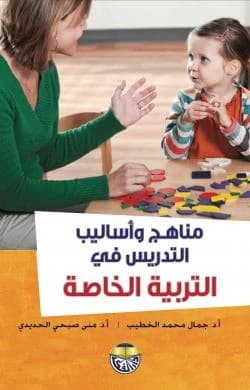
Curricula and Teaching Methods in Special Education - Prof. Dr. Jamal Al-Khatib & Prof. Dr. Mona Al-Hadidi
JOD

Get it by 5 Aug | Order in 5 Hours 12 Minutes
- Return Policy
- Warranty Policy
- Shipping Policy
- Non contact delivery
- Personal Receipt
- Return Policy
- Warranty Policy
- Shipping Policy
- Non contact delivery
- Personal Receipt
Significant changes have occurred over the past four decades in the training and education of students with special needs. There has been a growing interest in human societies to provide growth and educational opportunities for these individuals, and knowledge, methods, and educational tools have evolved. A quick review of the literature on training children with disabilities shows that special education programs bring about important changes in their lives.
This reality has prompted various countries worldwide to enact legislation and laws that guarantee the rights of children with disabilities to receive effective and appropriate education. Moreover, special education is based on the principle of equal opportunities for all, and education is a fundamental right for all members of society. Special education also emphasizes that a child with a disability is a child first and has a disability second, and that the similarities between children with and without disabilities are greater than the differences.
All children, whether typical or with disabilities, learn and have the capacity for maturity and growth, although this may occur in different ways and at varying rates and levels. Children with special needs are those who differ in some way from children whom society considers typical. Specifically, we are talking about children whose physical, mental, or behavioral performance differs substantially from that of their peers.
Drawing a clear line between normal and abnormal or atypical performance is extremely difficult. Performance can deviate from what is considered normal without becoming atypical. Therefore, our definition of atypical individuals or those with special needs necessarily depends on the degree, frequency, and extent of deviation from the norm (Kirk & Gallagher, 1993). Based on this, students with special needs are those who differ from typical individuals significantly and persistently or frequently, which limits their ability to succeed in basic social, educational, and personal activities.
This new edition of the book aims to keep pace with contemporary developments and directives in teaching these students.
- Author: Prof. Dr. Jamal Al-Khatib, Prof. Dr. Mona Al-Hadidi
- Number of Pages: 304
- Year of Publication: 2021
- Binding Type: Hardcover
- Edition: Eighth
- Print Color: Black & White
- Dimensions (cm): 17x24
- Weight (kg): 0.611
- Barcode: 9789957075682







