
Download Our App
Shop your way




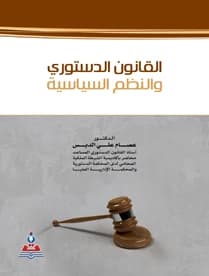
Constitutional Law and Political Systems by Dr. Essam Ali Al-Dabs
JOD

Get it by 5 Aug | Order in 5 Hours 12 Minutes
- Return Policy
- Warranty Policy
- Shipping Policy
- Non contact delivery
- Personal Receipt
- Return Policy
- Warranty Policy
- Shipping Policy
- Non contact delivery
- Personal Receipt
We would like to acknowledge that writing a book on political systems and constitutional law is a challenging and arduous task, especially since this book is taught to first-year university students. Its particular importance extends to postgraduate students who study this subject in-depth, and it is also significant for educating citizens politically and constitutionally about the fundamental principles of political systems and constitutions in our contemporary world. In this context, it is essential to present the information and ideas in this book with simplicity, avoiding theoretical jurisprudential debates and arguments, and to strongly present general concepts and their branches to encourage the reader to ask questions that lead to further research on related topics and a deeper study of the intellectual, philosophical, political, constitutional, and legal dimensions that answer their queries about the subject matter of this book.
This is what we have tried to achieve while teaching Constitutional Law and Political Systems to law students at both the undergraduate and postgraduate levels (Master's and Ph.D.). This book comprehensively covers the lectures that have been and will be delivered to students, forming the core of this work. Additionally, preparing the academic material for this book required a scientific exploratory journey, soaring and sailing around the world to gain a close and detailed understanding of the various and diverse political systems in contemporary nations. We were delighted and enjoyed the research, exploration, and engaging reading during this journey of discovering these political systems, which have been conveyed with complete academic integrity to our dear students and readers in this book.
The term "Constitutional Law" was not known until 1797 in Italy, where it was decided to teach it in law faculties at Italian universities. The teaching of Constitutional Law began in French law faculties for the first time in 1834 when the Minister of Education, Guizot, decided to introduce the subject. The first professor of Constitutional Law at the University of Paris was Professor Rossi, a graduate of the University of Bologna, Italy. This historical origin in France linked constitutional law to the constitution of 1830 on one hand, and to the free democratic system that emerged during the 19th century, which guaranteed individual rights and freedoms, on the other. On March 27, 1954, a French decree added the subject of "Political Systems" to Constitutional Law, creating the course "Constitutional Law and Political Systems." This subject was subsequently taught in universities in other countries, including Arab nations.
The term 'political system' consists of two words: 'system' and 'politics.' A system refers to the arrangement of a set of tangible and intangible elements in an interconnected manner to achieve a specific goal. Politics refers to the method used to manage a particular field.
Regarding the meaning of political systems, while some jurists see the terms 'Constitutional Law' and 'Political Systems' as synonyms because political systems refer to the system of governance in a particular state, which is what constitutional law covers, the majority of jurists argue that the meanings of constitutional law and political systems are different. Although the core focus of both is the same, constitutional law deals with the abstract legal aspect of the state's governance system, whereas political systems, starting from the legal aspect, also consider the political, economic, social, and cultural factors that influence the governance system.
Based on the above, some constitutional jurists believe that the term 'political system' refers to the set of political institutions in a state among which the mechanism or authority of political decision-making is distributed. They thus merge the concepts of constitutional law and constitutional system, limiting the study of political systems to the legal or organizational framework of governance, such as defining the form of the state or government and its functions as specified in the constitution, without examining their application and interaction with political, economic, social, cultural, and historical aspects. However, the majority of constitutional jurists include within the scope of studying political systems, in addition to the state's public authorities, the bodies and organizations that influence, in one way or another, the policies adopted by the state through direct or indirect intervention to varying degrees in political, economic, and social affairs. These are known as civil society institutions, the most important of which are political parties and economic, social, religious, and intellectual pressure groups that defend interests and intellectual systems, if not fixed ideologies. Therefore, studying the political system of a country requires examining the prevailing intellectual system in all these fields, especially in the economic and social spheres, in addition to the purely political and legal aspects organized in the constitution that determine the form of government. Thus, one must consider the influences on this system arising from the reality surrounding each country, which are usually related to political, economic, social, intellectual, religious, historical, and sometimes security reasons. Due to these various considerations, we can say that the political systems applied in our contemporary world are also different and numerous because they are the product of the influence of all these factors.
From the foregoing, a political system can be defined as "the pattern of governance to which a particular state is subject." It is not just a set of institutions but also implies a specific structure of a party system, an electoral model, a framework of economic and social institutions, historical traditions, cultural discourse, and other values—in short, all structures in their political manifestations.
Thus, there is no synonymy, but rather a complementarity between the concepts of constitutional law and the political system in a state.
Within this framework, constitutional and political jurisprudence, when researching the subject of political systems, examines the foundations of political organization, which includes the state, government, public rights and freedoms, and contemporary political systems. It often analyzes the political system of a specific country of which the researcher is a citizen. We will follow the same methodology used by this constitutional jurisprudence.
Since political organization in its contemporary form in any group or society is based on the existence of a state, which represents the supreme political authority, this supreme political authority in the modern state is exercised by the government as the body that manifests this authority, in the manner specified by the state's constitution.
The constitution, which forms the legal framework for political organization, defines the relationship between rulers and the ruled—that is, between political authority and individuals. The individual's relationship with the state on one hand, and with the supreme political authority on the other, is determined by their respect for and protection of public rights and freedoms, in exchange for the individual's submission to all legal rules in the state by performing the duties and obligations imposed by legislation.
Linguistically, 'dastur' (constitution) is a word of Persian origin meaning 'foundation,' 'structure,' or 'rule,' which has been adopted by the Arabic language. The French word 'constitution' linguistically means 'establishment' or 'formation'.
Constitutional jurisprudence is divided into two approaches when defining a constitution: the first focuses on the text of the constitutional document, and the second on the subject or content of the constitution. The approach that relies on the text adopts a formal criterion, while the one that relies on the subject matter adopts a substantive criterion.
Constitutional law includes the set of legal rules related to the system of governance in a state, which aims to organize public authorities (i.e., the political organization), define their competencies and relationships, specify the rights and duties of individuals, and establish the philosophical and ideological foundations of the state's political system.
In this context, when political and constitutional jurisprudence researches the subject of constitutional law, it examines the general principles that govern constitutions—with variations in main headings—which include the nature of constitutions, their origins, types, amendment, and abolition. It also addresses their nature, respect for them, and constitutional review.
The foregoing constitutes the content of this book. We hope that we have succeeded in its completion and that accuracy, precision, and academic integrity have been our allies in addressing its topics. Success, of course, is from God Almighty, the All-Knowing, to whom alone belongs perfection, while all else is characterized by imperfection and limited capabilities.
- ISBN: 9789957167967
- Weight: 0.950 kg
- Dimensions: 17×24 cm
- Paper: White
- Pages: 520
- Year of Publication: 2014
- Binding: Hardcover







