
Download Our App
Shop your way




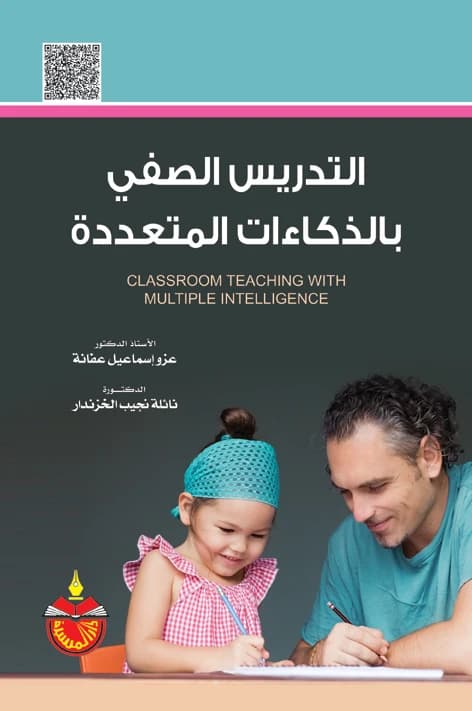
Classroom Teaching with Multiple Intelligences - Izzo Ismail Afanah (2014)
JOD

Get it by 5 Aug | Order in 5 Hours 20 Minutes
- Return Policy
- Warranty Policy
- Shipping Policy
- Non contact delivery
- Personal Receipt
- Return Policy
- Warranty Policy
- Shipping Policy
- Non contact delivery
- Personal Receipt
The subject of this book is one of the modern topics that has begun to find its way into classroom teaching, due to the changing perspective on intelligence and its nature. Therefore, this book is a new attempt to equip our students with multiple intelligences by planning lessons in various academic subjects. The content of this book focuses on the most important strategies that work to develop multiple intelligences in classroom teaching. Previously, intelligence was seen as a comprehensive concept that an individual could possess through a single type of intelligence. However, Gardner's theory of multiple intelligences has changed the traditional concept of intelligence; a learner can be intelligent in one area while being less so in another. From this standpoint, our interest in Gardner's theory is to develop multiple intelligences in our students by teaching instructors how to deal with these intelligences and how to prepare lessons to cultivate them in learners. Humans, in reality, possess eight types of intelligences, and the intelligences present in one individual may differ from those in another. Consequently, when a teacher teaches through these intelligences, they should first understand the characteristics of their students to be able to impart certain intelligences or reinforce others. Multiple intelligences are also linked to thinking patterns and quality. A learner with certain intelligences will have high-quality thinking in that domain. Therefore, managing and organizing thinking helps in developing multiple intelligences among learners. This requires the teacher to be aware of thinking management and organization strategies, such as the self-questioning strategy, concept mapping strategy, brainstorming strategy, and total quality thinking strategy, among others. These strategies are important and useful in classroom teaching, especially when learners seek to modify their thought processes and reorganize their ideas, which hones their intelligences and gives them the ability to creatively handle classroom situations. Hence, focusing on achievement levels of recall, comprehension, and application is no longer sufficient in the face of modern changes and cultural diversity. We should focus on how to equip our students with multiple intelligences in classroom teaching so they are ready to interact with others in ways that align with their principles and values. Based on these premises, this book was written to consider the intellectual abilities of learners and to urge teachers to develop multiple intelligences in their students due to its great importance in dealing with complex and rapidly accelerating scientific and technological developments. This is especially true at a time when the world has become a single global village where multiple cultures pour into every society and influence it. If there are no intellectual abilities to deal with the variables of this era, learners will be in one world and the world in another. We do not mean here that the learner should benefit from their intelligence in a certain field to acquire specific cultures, but rather to be aware of what is happening in the world, to use their intelligence to distinguish between good and bad, and to impose their thinking on others instead of having their thinking be passive, affected but not affecting. The book you have in your hands addresses this topic in eight chapters. The first chapter clarifies the nature of effective classroom teaching, its components, the quality characteristics of its inputs, and some modern classroom teaching methods. The second chapter explains the traditional view of intelligence and presents some theories of intelligence. The third chapter deals with the modern view of intelligence, clarifying the difference between traditional and modern intelligence, and comparing different theories of intelligence with a focus on Gardner's theory of multiple intelligences. The fourth chapter discusses the measurement of multiple intelligences, especially the historical aspect of intelligence measurement, critiques of intelligence tests, the development of methods for measuring multiple intelligences, and some models for measuring them. The fifth chapter addresses the relationship between multiple intelligences and the brain, including the components and functions of the nervous system, brain components, whole-brain learning, the relationship of multiple intelligences to the brain hemispheres, and the classroom climate suitable for learning with both hemispheres. The sixth chapter focuses on multiple intelligences and their relationship with metacognitive strategies, including the relationship of multiple intelligences to the cognitive system, metacognitive skills, the importance of acquiring metacognitive skills, components of metacognition, the relationship between thinking and metacognitive processes, and strategies for teaching metacognitive skills. The seventh chapter addresses how to develop multiple intelligences through the school curriculum, covering the developmental progression of intelligence, teacher strategies for multiple intelligences, characteristics of the intelligent learner, multiple intelligences and the school curriculum, and curricula based on Gardner's theory. The final chapter (the eighth) focuses on instructional planning for developing multiple intelligences, containing the relationship of the theory of multiple intelligences to teaching and learning mathematics, instructional checklists for the teacher to develop multiple intelligences, a lesson planning matrix based on multiple intelligences, and models for planning lessons through multiple intelligences.
- Number of Pages: 264
- Year of Publication: 2014
- Binding Type: Hardcover
- Edition: 3
- Printing Color: Black
- Size (cm): 17x24
- Weight (kg): 0.550
- Barcode: 9789957063238







