
Download Our App
Shop your way




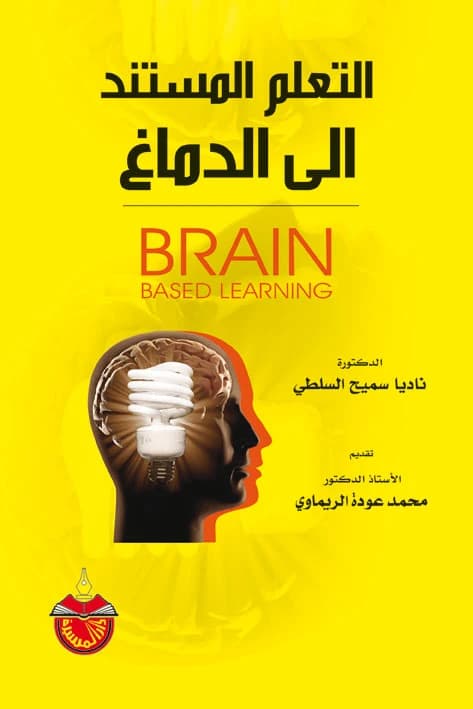
Brain-Based Learning - Dr. Nadia Samih Al-Salti - 2009
JOD

Get it by Tomorrow | Order in 12 Hours 30 Minutes
- Return Policy
- Warranty Policy
- Shipping Policy
- Non contact delivery
- Personal Receipt
- Return Policy
- Warranty Policy
- Shipping Policy
- Non contact delivery
- Personal Receipt
This is a book on learning, with a title that might seem unusual to those accustomed to reading about learning through its more widespread and established traditional theories, such as the behavioral, cognitive, and social theories, and their prominent figures like Pavlov, Thorndike, Skinner, and Piaget. This uniqueness may drive the reader to explore this new approach to learning and motivate them to delve deeper into this cutting-edge field. If the title achieves this goal, it has served its purpose.
If you decide to venture into this unknown territory, you will not be disappointed, nor will you sever ties with the learning theories you already know. You will find yourself directly engaged with the brain—its structure and function. The first chapter, 'Introductions to Brain-Based Learning,' places you in the context of brain models throughout history, reviewing the evolution of traditional educational and cognitive psychological models.
Starting with the second chapter, dedicated to the biological and physiological foundations of brain-based learning, you will enter a field that may seem unfamiliar, closer to cognitive neuroscience—a hybrid born from the intersection of specialized research in the brain and cognitive psychology. You will read about the fundamental structure of the human brain, its external morphological characteristics, internal composition, neurons and their components, and the cerebral differences between genders.
After understanding the brain's structure, the third chapter logically guides you through its mechanisms in light of modern brain research, examining the brain's links to the body, emotions, and the social environment.
The fourth chapter, 'The Mechanism of Learning in Light of Modern Brain Research Findings,' confirms that the best thing the brain does is learn. Any new learning changes the brain by reorganizing itself and altering its electrochemical network. This chapter details the factors affecting brain-based learning and its stages, focusing on the theory of brain-based learning, its twelve core principles, and the teaching-learning strategies based on them. It concludes by comparing the characteristics of brain-compatible learning with brain-antagonistic learning.
Following this, the fifth chapter explores the relationship of this type of learning with variables such as academic achievement, motivation, transfer of learning, information processing, multiple intelligences, and creativity.
The sixth and seventh chapters are dedicated to educational applications based on the theory of brain-based learning. Chapter six provides guidance for teachers to enhance learning, while the final chapter presents models of educational activities based on brain principles, offering a rich field for teachers' creativity.
In conclusion, this type of learning is based on the latest developments in neuroscience and offers great flexibility to incorporate new discoveries. We hope to spread this approach to learning among educators and anyone interested in innovation and development in the field of teaching and learning.
- Number of Pages: 240
- Year of Publication: 2009
- Binding: Hardcover
- Edition: 2
- Printing Color: Black
- Dimensions (cm): 17x24
- Weight (kg): 0.550
- Barcode: 9789957062279







