
Download Our App
Shop your way




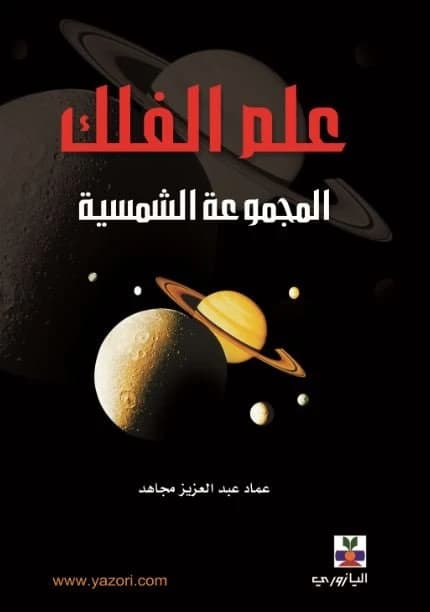
Astronomy: The Solar System - Author: Prof. Imad Abdul Aziz Mujahid
JOD

Get it by 5 Aug | Order in 3 Hours 51 Minutes
- Return Policy
- Warranty Policy
- Shipping Policy
- Non contact delivery
- Personal Receipt
- Return Policy
- Warranty Policy
- Shipping Policy
- Non contact delivery
- Personal Receipt
When a young researcher presents the Arab reader with a book explaining “Our Contemporary View of the Solar System,” he provides an opportunity to explore the latest insights from modern scientific and technical means. This book offers a detailed picture of the world that surrounds us, a world we have known and lived with from a distance since the days of our ancestors in Mesopotamia and the Nile Valley. Our relationship with the solar system, despite its intimacy, remained non-detailed, even with the Moon, our Earth's closest celestial neighbor. This was the case until advanced technologies intervened, bringing back samples of its soil and rocks to Earth and landing the first human being on its profoundly still and desolate surface, which we once understood only as light reflected from the sun's lamp.
This is what the astronomer Imad Mujahid has done in his book. After presenting his works on the “History of Astronomy,” “Star Atlas,” “The Islamic Arab Astronomical Calendar,” and “The Muslim Astronomer's Guide,” and after discussing the myth of astrology between science and religion in another book, he grounds the reader in science and truth regarding the characteristics of the master of the solar system and its progeny of planets, moons, asteroids, and comets, each swimming in its own orbit.
It is not easy to summarize the contents of this book; it is not a literary work but a scientific one, brimming with descriptive information, tables, images, and figures. It must be taken as it is, as the author has made every effort to include summaries of studies and measurements from spacecraft, in addition to what the world's largest astronomical observatories have revealed, which has overturned our old views and corrected our concepts and perceptions of the solar system.
The history of science itself is a continuous process of approaching objective existence to provide our memory and records with data, values, and forms about the subject under study. The closest distances covered and the most precise observations made are what have been achieved by space probes carried on spacecraft since the space race intensified between the Soviet and American blocs, especially in the early 1980s. Humanity has been gifted with the results of successful missions like Mariner, Pioneer, Venera, Viking, and Venus, and we still look forward to more discoveries, studies, measurements, and images that represent the furthest humanity has reached in exploring the universe around us.
The number of moons orbiting planets has changed, as have the data and figures that were once established through remote study and investigation, from the discovery of Mars's moon Phobos by Asaph Hall in 1877 to the latest astronomical report received as a wireless message from an unmanned vehicle or a giant observatory still awaiting messages that have been traveling through space for millions of years. The modification and correction of humanity's view of the universe have had effects that touched various aspects of life, not just astronomical science.
Hence the importance of renewing and updating our concepts and our view of the world around us, starting from the corner closest to us, from the family we belong to astronomically: the Solar System. The strenuous effort an author puts into a work like Mujahid's book is only rewarded and justified by the Arab reader's access to this important contemporary scientific material, so that the reader can keep pace with this fast-moving era, crowded with new developments in every field.
Finally, while I am pleased to contribute by reviewing the works of my colleague Imad Mujahid, I am even more pleased to read more of his scientific works, which are lacking in the Arab library in the field of astronomy—a noble science that originated in the Fertile Crescent and Egypt. However, its most important centers are now in the Caucasus, Crimea, France, Germany, Britain, the Netherlands, the United States, and Chile, while the Egyptian-Arab Observatory is not considered among the major observatories. It is also a source of feeling of Arab inadequacy towards the contemporary astronomical scientific revolution that we do not find many Arab names among international researchers and scholars like Professor Farouk El-Baz (the geologist) who contributed to the American space programs. Let us read and seek more knowledge, for tomorrow belongs to those who do not want relaxation, laziness, or corruption, but prepare for tomorrow with serious work and sound scientific planning.
- Weight: 0.72 kg
- Dimensions: 17 × 24 cm
- ISBN: 978-9957-12-850-0







