
Download Our App
Shop your way




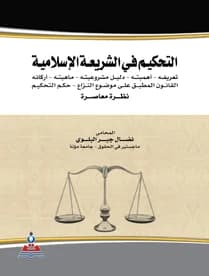
Arbitration in Islamic Sharia - A Contemporary Perspective by Nidal Jabr Al-Balawi
JOD

Get it by 5 Aug | Order in 5 Hours 11 Minutes
- Return Policy
- Warranty Policy
- Shipping Policy
- Non contact delivery
- Personal Receipt
- Return Policy
- Warranty Policy
- Shipping Policy
- Non contact delivery
- Personal Receipt
In the name of Allah, and He is sufficient. Praise be to Allah who chose His servant and prophet, the Prophet of guidance, Muhammad bin Abdullah, the unlettered Arab prophet, who does not speak from his own desire. He came conveying the law of Allah as a mercy to His chosen servants, so that they would not judge by their whims.
I praise Him in whose nation's differences there is mercy. The differences among the scholars of the Ummah were not out of whim, but rather were the jurisprudence and ijtihad that are the hallmark of every influential, dominant civilization, not a vanquished one. When ijtihad dies, it is a sign of affliction and sickness in the Ummah.
As I present this work, I recall writing a research paper for our esteemed professor, Dr. Musleh Al-Tarawneh, in which I attempted to highlight some ideas and enlightened opinions from contemporary jurisprudence, especially regarding the conditions required for an arbitrator and a judge according to the jurisprudence of the predecessors, with reference to today's reality.
The issue of referring to the rules of Islamic Sharia as applicable rules in arbitration disputes was also addressed. We discussed practical cases where such a condition was not applied before arbitration panels that saw it as a clause involving ambiguity, and the questioning began... is what is said in this regard justified?
From here, the idea for this research was born, but it was an idea accompanied by a fear of sailing in the ocean of Islamic jurisprudence, which is said to be a sea without a shore, along with apprehension of its profound language and difficult terminology. However, perseverance, determination, and the encouragement of more than one of our eminent professors pushed me forward, with my heart saying: He who makes no mistakes does nothing, and no work can be perfect, for perfection belongs to Allah Almighty alone.
At the beginning of this research, I thought I would face a problem in authentication. However, the efforts of those before me in authenticating the opinions of scholars on the issue of arbitration were a great help in facilitating my task. The tremendous efforts in the movement of renewal in Islamic jurisprudence after the middle of the last century had a significant impact in assisting me. The Kuwaiti Fiqh Encyclopedia is the best evidence of these blessed efforts. Whenever I wanted to authenticate, I returned to it as a guide and a mentor, directing me to the primary source books. Sometimes, its clarity was such that it obviated the need to return to the old primary source books, which I referred to for the purpose of contemplation and reflection on jurisprudential opinion.
- ISBN: 9789957167158
- Weight: 0.800 kg
- Dimensions: 17x24 cm
- Paper: White
- Pages: 376
- Year of Publication: 2012
- Binding: Hardcover







