
Download Our App
Shop your way




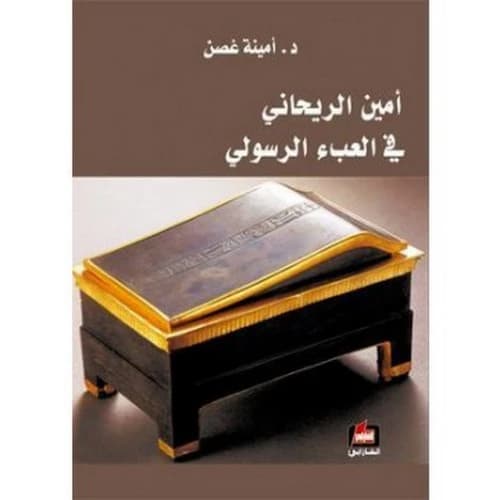
Ameen Al-Rihani in the Apostolic Burden - Amina Ghosn - 2011 - Dar Al-Farabi
JOD

Get it by 5 Aug | Order in 3 Hours 9 Minutes
- Return Policy
- Warranty Policy
- Shipping Policy
- Non contact delivery
- Personal Receipt
- Return Policy
- Warranty Policy
- Shipping Policy
- Non contact delivery
- Personal Receipt
Ameen Al-Rihani (1876-1940) returns after a hundred years carrying "The Book of Khalid" and his liberationist doctrine, which posits that the "individualism" advocated by Stoicism, Epicureanism, and Cynicism compels its follower to be an arsonist or a highwayman, defiant and unguarded. Ameen Al-Rihani, preoccupied with the Eastern man crowded by different religions, refused to derive religion from the triliteral root "dana," meaning to humiliate and enslave. Like Goethe's Faust, he says: "Since I decided to leave the edge and climb the abyss in search of the next edge, I deliberately left safety behind and accepted the risk." And like Nietzsche, he says: "The snake that cannot shed its skin perishes." In a stagnant, unchanging environment, the "non-belonging" professed by Hesse becomes the highest form of life known to civilizations, after prophecy. Colin Wilson said of the non-belonger that Ameen Al-Rihani was: he is essentially a stubborn man living in a decadent society, writing without being obliged to please anyone but himself, even if he is accused of blasphemy, excommunicated, and branded an atheist. Ameen Al-Rihani, haunted by the obsession with "white writing," was the one who planted creative questions in prophecies and science. He alternately led the bet of incitement and difference, and decided to carry the burden of his two cultures and legacies to reconcile within them an experimental West and an abstract, spiritually vibrant East.
About the Author:
Dr. Amina Fares Ghosn, holds a Ph.D. in Semiotics and Linguistics from the Sorbonne University - Paris.
- Recipient of the Fulbright award, University of Michigan - USA 1987-1988.
- Professor at the American University of Beirut (AUB) 1980-2004.
- Professor at the Lebanese American University in Beirut (LAU) 1986-1993.
- Professor at the Holy Spirit University of Kaslik 2004-2005.
- Professor at the Hariri Canadian University 2006.
Book Details:
- Publishing House: Dar Al-Farabi for Publishing and Distribution
- Year of Publication: 2011
- Number of Pages: 224
- ISBN: 9789953716732







