
Download Our App
Shop your way




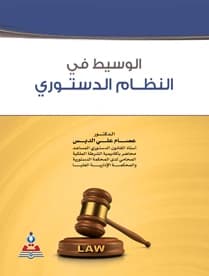
Al-Wasit in the Constitutional System by Dr. Essam Ali Al-Dabs
JOD

Get it by 5 Aug | Order in 3 Hours 49 Minutes
- Return Policy
- Warranty Policy
- Shipping Policy
- Non contact delivery
- Personal Receipt
- Return Policy
- Warranty Policy
- Shipping Policy
- Non contact delivery
- Personal Receipt
We would like to acknowledge that writing a book on the Jordanian constitutional system is a daunting and not an easy task, especially since this book is taught to first-year university students. It also holds special importance for postgraduate students as it is taught as an in-depth study. This importance extends to citizens, aiming to educate them politically and constitutionally about the fundamental principles of constitutional systems, the constitutions of contemporary world nations, and the Jordanian constitutional system. In this context, it is essential to adopt simplicity in presenting the information and ideas of the book, avoiding theoretical jurisprudential debates, and strongly presenting generalities and their branches to open the way for the reader to ask questions that lead them to research related topics and delve deeper into the intellectual, philosophical, political, constitutional, and legal dimensions that answer their queries about the subject matter of this book.
This is what we have tried to achieve while teaching the Jordanian constitutional system to law students at both the undergraduate and postgraduate levels, which include Master's and PhD degrees. This book is a comprehensive compilation of the lectures that have been and will be delivered to students, forming the core of this work. Additionally, preparing the scientific material for this book required an exploratory scientific journey, soaring and sailing around the world to get a close-up look at the various and diverse constitutional systems in our contemporary world. This was for the scientific benefit that reflects on the study of the Jordanian constitutional system. We were also pleased and enjoyed the research, exploration, and delightful reading during the journey of getting to know these constitutional systems, which have been conveyed with complete academic integrity to our dear students and readers in this book.
The Executive Authority, or the Procedural Authority as the Lebanese constitutional legislator calls it, is the main authority among the three public powers. It is impossible to imagine a state without an executive authority, but one can imagine a state without legislative and judicial authorities, or with them being merely symbolic, as in authoritarian states where the executive authority dominates all aspects of the state and encroaches upon the other two authorities.
The importance, and indeed the danger, of the executive authority lies in the fact that it exercises its function permanently and continuously, unlike the legislative authority whose activity may be interrupted because it does not operate permanently, working for a specific period of the year, and parliament may sometimes be dissolved for a relatively long period. The executive authority, by virtue of its administrative activity, enjoys many and varied privileges represented by the manifestations of public authority, its use of public law means, and the availability of material resources and specialized human technical expertise from its daily and direct contact with individuals, especially in the modern state which has transitioned from a guardian state to an interventionist one. The state's role is no longer limited to satisfying the general needs of individuals but has also intervened in individual activities and in many complex technical matters. As the executive authority implements the state's interventionist policy, the burdens placed upon it have increased, and its fields of activity have multiplied and expanded. Ensuring the protection of citizens and laws, working for their implementation, and protecting and maintaining public order in its various elements—public security, public tranquility, public health, and public morals and decency—have become secondary tasks of the executive authority. The function of the executive authority today differs radically from the recent past, where public administration was merely a means to implement the goals and policies set by the state's supreme authority. Today, public administration contributes mainly to defining goals, shaping policies, and then making and implementing decisions. In other words, the role of public administration has shifted from mere implementation to contributing to the making of the state's public policy, and even beyond that to developing the necessary strategy to transform this policy into decisions on the ground that achieve the state's objectives in all political, economic, social, and cultural fields. As the executive arm of the state, the executive authority monopolizes military power and the state's material revenues and enforces the law by force to protect the public interest and public order, run public facilities, and ensure their continuity and regularity.
Therefore, the constitutions of contemporary world nations, including the Jordanian constitution, work to define the powers of the executive authority precisely and subject its actions to the supervision of the legislative and judicial authorities, according to the concept adopted by the constitutional legislator for the principle of separation of powers.
The term "Constitutional Law" was not known until 1797 in Italy, where it was decided to teach constitutional law in the law faculties of Italian universities. The teaching of constitutional law in the law faculties of French universities began for the first time in 1834 when the Minister of Education "Guizot" decided to teach this subject. The first professor of constitutional law at the University of Paris was Professor "Rossi," a graduate of the Italian University of “Bologna.” This historical origin of constitutional law in France led to the connection between constitutional law and the constitution of 1830 on one hand, and between constitutional law and the free democratic system that emerged during the nineteenth century, which guaranteed the rights and freedoms of individuals, on the other. On March 27, 1954, a French decree was issued adding the subject of "Political Systems" to constitutional law, making it the subject of Constitutional Law and Political Systems. Subsequently, this subject was taught in the universities of other countries, including Arab nations.
Linguistically, the word "Dustour" (constitution) is of Persian origin, meaning foundation, structure, or rule, and the Arabic language adopted this word. The French word "Constitution" linguistically means establishment or formation.
Constitutional jurisprudence is divided into two trends in defining the constitution: the first focuses on the text of the constitutional document, and the second on the subject or content of the constitution. The trend that relies on the text of the document adopts a formal criterion in its definition, while the trend that relies on the subject or content adopts a substantive criterion.
Constitutional law includes the set of legal rules related to the system of government in the state, which aim to organize the public authorities—that is, the political organization—within it, define their powers and the relationship between them, determine the rights and duties of individuals, and the philosophical and ideological foundations upon which the political system of the state is based.
We would like to point out that the term constitution and the term constitutional system are different, whereas the constitutional system and the term political system are synonymous.
In this context, political and constitutional jurisprudence, when researching the subject of constitutional law, deals with the general principles of constitutional law—with differences in main titles—which are: the nature of constitutions, their origin, types, amendment, abolition, nature, respect for them, and constitutional review.
The current Jordanian constitution of 1952 defined the nature of the system of government in the Jordanian state, stating in its first article that the system of government is parliamentary, monarchical, and hereditary. The Jordanian constitutional legislator adopted the parliamentary system. Since there is no single parliamentary system in the world, but rather several parliamentary systems or a family of parliamentary systems with common characteristics, it adopted the dual form of the parliamentary system and not the individual or pure parliamentary system. This system is based on two main pillars: the duality of the executive body or the executive authority, represented by the presence of a head of state and a ministry, where the head of state is not responsible, and the collective and individual political responsibility of the ministry is established, and the balance and cooperation between the executive and legislative authorities.
Under the dual parliamentary system adopted by the Jordanian constitutional legislator, the head of state, the King, was granted actual and extensive powers that he exercises himself, thus tipping the scales in favor of the head of state over the ministry, unlike the pure individual parliamentary system, under which the scales are tipped in favor of the ministry over the head of state.
The current constitution organized the work of the executive authority and defined its relationship with other authorities, especially the legislative authority. Article 26 of the constitution vested the executive authority in the King, which he exercises through his ministers in accordance with the provisions of this constitution.
The current constitution dedicated its fourth chapter to the executive authority, which includes Articles 28-57, and divided the chapter into two sections: the first section: The King and His Rights, and the second section: The Ministers. Article 94 of the same constitution stipulates the right of the executive authority to enact provisional laws. Articles 45/1, 114, and 120 stipulate the right of the executive authority to issue independent regulations, and Articles 124 and 125 stipulate its right to declare states of emergency and martial law.
The current Jordanian constitution of 1952 organized the work of the legislative authority and defined its relationship with other authorities, especially the executive authority. Article 25 vested the legislative authority in the National Assembly and the King, and stipulated that the National Assembly consists of the Senate and the House of Representatives. Article 62 came to decide that the National Assembly is composed of the Senate and the House of Representatives, stating, "The National Assembly is composed of two houses: the Senate and the House of Representatives." Thus, in organizing the parliament, the Jordanian constitutional legislator adopted the bicameral system and not the unicameral or single-chamber system.
Regarding legislative competence, the Jordanian constitution did not limit this right to the legislative authority alone but also granted it to the executive authority. It decided to grant the executive authority the right of subsidiary legislation by issuing various types of regulations, both executive and independent, as stipulated in Articles 31, 45/2, 114, 120, and 125. It did not stop there but went further and also granted the executive authority the right of legislation by enacting provisional laws issued under Article 94, giving these laws the legal force of ordinary laws issued by the legislative authority. It granted this right in the absence of the legislative authority, when the National Assembly is not in session or is dissolved, and the conditions of necessity and urgency are met. The danger of these provisional laws lies in their power to repeal or amend any ordinary law issued by the legislative authority, which of course leads to the executive authority being considered the ordinary legislator while the legislative authority becomes the exceptional legislator!
If the application and implementation of the principle of separation of powers according to its absolute concept requires each of the three authorities in the state to perform its constitutionally defined competencies, and does not permit any authority to perform the competencies of another, and if it does so, it constitutes an infringement on the competencies of another authority, then the Legislative Authority, according to this concept, is the owner of general jurisdiction and the original competence in legislation, and no other authority, especially the executive authority, is allowed to dispute or share this original competence and legislate.
However, with the development that occurred in the concept of this principle, where it moved from an absolute concept to a relative and flexible one, this relative concept allows one of the public authorities to perform the competence of another authority. This results in the executive authority undertaking the competence of legislation by enacting subsidiary legislation in the form of regulations, including independent regulations, to enable the administration to exercise its administrative activity aimed at satisfying the general and basic needs of individuals and maintaining public order in its various elements: public security, public tranquility, public health, and public morals and decency.
Thus, the competence of legislation is no longer limited to the legislative authority; the executive authority also performs this competence by enacting legislation. The performance of the legislative function and competence by the executive authority is stipulated in most constitutions of the world, including democratic countries like France. The constitution of the Fifth French Republic, the current constitution issued in 1958, provides for the right of the executive authority to enact subsidiary legislation and issue regulations, especially independent regulations, under Article 37 of this constitution. This constitution went even further by limiting the legislative competence of the legislative authority to subjects listed exclusively in Article 34. Anything outside this list falls within the competence of the executive authority under Article 37. Even the legislative competence of the legislative authority, which is exclusively defined by Article 34, is not absolute; the executive authority can legislate in setting the basic provisions mentioned in the fourth paragraph of Article 34. The matter did not stop there; the current constitution provided for constitutional protection for the regulatory domain mentioned in Article 37, under Articles 37/2, 41, and 61. This led French administrative and constitutional jurisprudence to consider it a revolution in the relationship between law and regulations, and also a revolution in the relationship between the legislative and executive authorities, where the latter, the executive authority, has become the ordinary legislator, while the legislative authority has become the exceptional legislator!
Regarding the judicial authority, especially the constitutional judiciary, the 2011 constitutional amendment included the establishment of a constitutional court in its fifth chapter under the provisions of Articles 58, 59, 60, and 61. Thus, the constitutional legislator moved from decentralized constitutional review to centralized constitutional review.
- ISBN: 9789957167974
- Weight: 1.100 kg
- Size: 17×24 cm
- Paper: White
- Pages: 608
- Year of Publication: 2014
- Binding: Hardcover







