
Download Our App
Shop your way




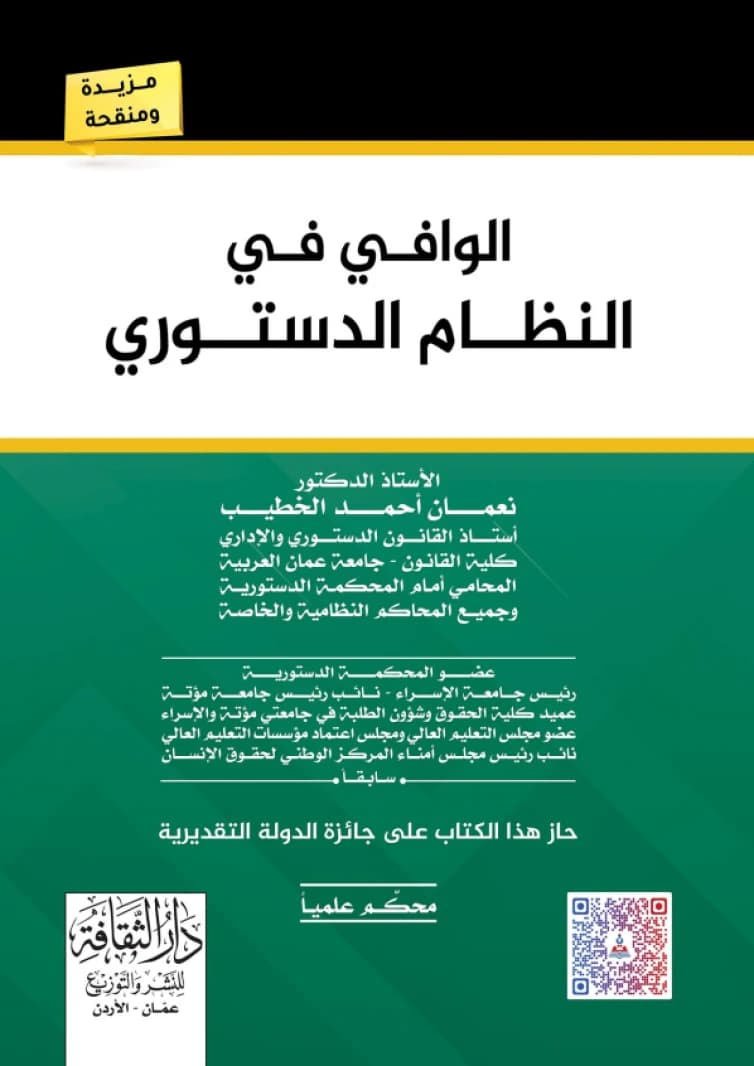
Al-Wafi on the Constitutional System by Prof. Dr. Numan Ahmed Al-Khatib
JOD

Get it by 5 Aug | Order in 3 Hours 15 Minutes
- Return Policy
- Warranty Policy
- Shipping Policy
- Non contact delivery
- Personal Receipt
- Return Policy
- Warranty Policy
- Shipping Policy
- Non contact delivery
- Personal Receipt
Praise be to Allah who guided me to this, and I would not have been guided had Allah not guided me; my success is only by Allah.
I began writing this book five years ago, when I felt the scarcity of specialized works explaining the Jordanian constitutional system and the system of governance in Jordan. This was coupled with the great need in Jordan's law faculties, which have grown to over fourteen colleges with about six thousand students, taught and supervised by nearly two hundred and fifty faculty members.
It is not only the needs of law faculties that motivate my colleagues and me to author books and write research. There are also numerous legal institutions composed of a large group of legal professionals who also need books and research to find what they seek and to support their opinions, whether they are judges, lawyers, consultants, or politicians.
Although the Jordanian constitutional system was a subject I taught for twenty-eight years at Mutah University, the University of Jordan, Amman Arab University, the Royal Police Academy, the War College, and the Judicial Institute, relying on a specific set of literature, my task in preparing this book was not easy. It was fraught with difficulties and challenges, represented by the scarcity of references, the sensitivity of some topics, the diverse composition and levels of the target audience, and the subsequent constitutional amendments made on 1/1/2011, issued on 28/9/2011, and published in the Official Gazette on 1/10/2011, which affected more than a third of the constitution's articles. Additionally, there was excessive change and amendment to fundamental legislation related to the Jordanian constitutional system, especially the Election Law for the House of Representatives No. (25) of 2012, amended by Law No. (28) of 2012, and the issuance of the Independent Election Commission Law No. (11) of 2012 and the Constitutional Court Law No. (15) of 2012, among others. Indeed, the increase in constitutional awareness among the general public and specialists—especially after the so-called Arab Spring—has increased the scope of responsibility and the weight of the task and effort required.
The constitutional amendments and the issuance of many of the laws we mentioned had significant effects on the Jordanian constitutional and political reality. This was manifested in the parliamentary elections for the seventeenth House of Representatives on 23/1/2013, conducted according to the provisions of the recent constitutional amendments, which became effective on 1/1/2011, and the amended Election Law for the House of Representatives No. (25) of 2012, under the supervision of the Independent Election Commission. These legislations included advanced provisions to ensure the integrity and fairness of the electoral process, and they established judicial supervision over most of its stages, culminating in the right of the judiciary, represented by the Court of Appeals, to rule on the validity of a member's seat in the House of Representatives.
I reiterate that I faced many difficulties and great challenges while preparing this book, which sometimes halted me and at other times delayed my writing. However, I would soon gather my strength and thoughts, immerse myself in my references and research, and return to my writing in one of the most difficult scientific fields, where opinions clash and passions collide. Yet, loyalty to science, the homeland, and the citizen was a source of inspiration and strength to continue on this arduous journey. It will become clear to the reader, after reviewing this work as well as the works of my colleagues in constitutional law and the Jordanian constitutional system, that a university professor, especially a professor of constitutional law, does not live—as some believe—in an ivory tower, but in the field of constructive political work. For if politics is our administration and our dignity, then the science of law is research and thought far from all sources of influence. And if rulers sail their ship in the sea of politics, the people of science must not be on that ship—not out of evasion or arrogance—but because they must be in the lighthouse that guides the ship to safe harbor with its light.
In presenting the topics of this book, I have tried to explain what 'is' in light of the constitutional texts and to show what 'should be' in light of jurisprudential theories and trends, to present the reader with future visions that can assist them in their respective positions, whether academic, legal, or political. I have dwelled on some topics, explaining them in detail as the subject and situation required, and presented others briefly in line with their nature and specificity, with the hope that this approach will serve everyone.
Writing about the Jordanian constitutional system requires the author not only to explain the Jordanian Constitution of 1952 with its more than sixty amendments, and the rules and provisions it contains regarding the state, its system of governance, the three authorities, the relationship between them and the citizen, guarantees for good governance, and the responsibility of the ruler and the ruled. Rather, understanding the constitutional system of any country does not stop at knowing its abstract legal components but extends to the surrounding informal institutions and activities that have a great impact on it, and to multiple sources that constitutional jurisprudence calls 'hidden forces,' such as pressure groups of various kinds, political parties with their ideologies, the press with its orientations and affiliations, and public opinion with its components and trends, along with the customary entitlements, connections, and historical roots of these official and unofficial institutions.
Since the current Jordanian constitutional system, based on the texts of the Constitution of the Hashemite Kingdom of Jordan of 1952 with its amendments, represents an advanced constitutional stage following historical and constitutional phases the Jordanian state has passed through, I have chosen to divide this book into two parts:
- Part One: I present the historical and constitutional development of the Jordanian state (1921-1952).
- Part Two: I dedicate this to the constitutional system of the Hashemite Kingdom of Jordan under the amended Constitution of 1952.
Thus, with God's grace, I have presented the Arab and Jordanian legal library with a fifth work to add to my four previous ones: 'Political Parties and Their Role in Contemporary Political Systems,' 'Principles of Political Systems,' 'The Concise in Constitutional Law,' and 'The Mediator in Political Systems and Constitutional Law,' which has been printed twelve times from 2000 to 2013, in addition to more than fifty scientific papers and working papers presented at Jordanian and international conferences and seminars.
Finally, to my teachers, a pledge of loyalty and a prayer for mercy and forgiveness. To my esteemed colleagues and to my dear children who have chosen education as their mission, I enjoin you to fear God and to preserve your knowledge and the sanctity of your message. Continue with generosity, truth, and loyalty to your nation, your homeland, and your children. Hold on to your dignity and self-respect in reverence for the sanctity and elevation of your knowledge—the dignity and pride of Imam Al-Shafi'i, may God have mercy on him, who, when the Abbasid Caliph Harun al-Rashid sent for him to teach his sons in his palace, replied, 'O Commander of the Faithful, knowledge does not come, but rather it is sought.' And the objectivity and humility of Abu Hanifa al-Nu'man, who always used to say: 'This knowledge of ours is an opinion, and whoever brings a better one, we accept it.'
ISBN: 9789957168537
Weight: 0.850 kg
Size: 17x24 cm
Paper: White
Pages: 448
Year of Publication: 2023
Binding: Hardcover







