
Download Our App
Shop your way




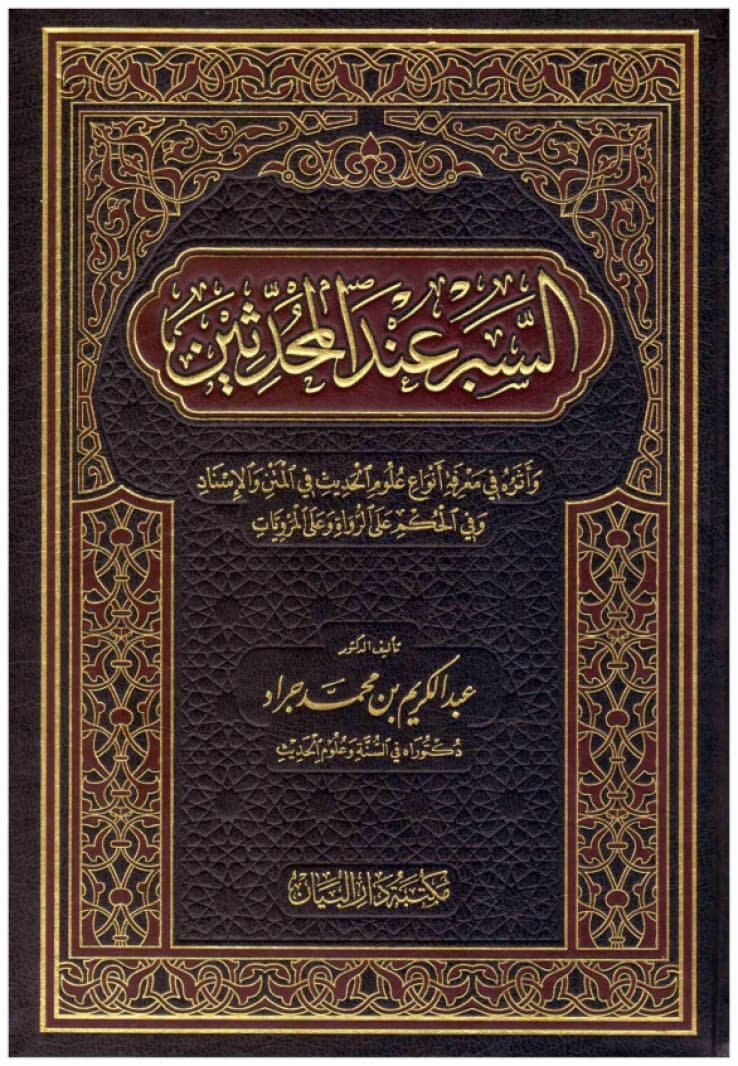
Al-Sabr Among Hadith Scholars by Abdulkarim bin Mohammed Jarad
JOD

Get it by 5 Aug | Order in 3 Hours 23 Minutes
- Return Policy
- Warranty Policy
- Shipping Policy
- Non contact delivery
- Personal Receipt
- Return Policy
- Warranty Policy
- Shipping Policy
- Non contact delivery
- Personal Receipt
The book on 'Al-Sabr' among Hadith scholars originates from a doctoral thesis, addressing key topics in distinguishing between 'Al-Sabr' and 'Al-Ei'tibar' in Hadith practices. It explains the scientific method in recognizing different types of Hadith sciences and identifying defects, along with evidences for preference and distinction.
The author begins with praise to Allah for sending His chosen Prophet with a clear book and enlightening tradition. Those who follow both walk in brightness, while those who turn away wander in darkness. The preservation of the Quran has been ensured by diligent scholars who devoted their lives to it. Similarly, dedicated men preserved the Sunnah, documenting it and traveling for its sake, thus earning unique honor of association with the Prophet's legacy.
As the Sunnah, being the second source in Islamic legislation, independently legislates and clarifies the Quran, there is a necessity to distinguish its authentic narrations. The rigorous scholars, being the discerning critics, worked tirelessly to protect the Sunnah from distortions and misunderstandings. They established rules governing Hadith narration and the assessment of narrators, leading to the development of Hadith sciences, including its principles, terminology, and critique.
One of the most profound principles in Hadith science is the rule of 'Al-Sabr,' which plays a crucial role in validation, critique, and understanding of Hadith. It involves collecting Hadith chains, comparing them, and highlighting their agreements and differences.
While 'Al-Sabr' might independently uncover defects or highlight benefits, it can also support other methods in Hadith sciences. It might be overlooked in certain cases where other methods suffice. Its significance can sometimes be definitive or merely supportive.
The importance of 'Al-Sabr' led to its detailed study, as it hasn't been extensively researched or classified separately in previous works. This book gathers dispersed discussions and studies applied methods from various texts.
An additional reason for this focus is practicality in attaining knowledge, emphasizing the empirical methodology over purely theoretical approaches. This scientific method in Hadith study uses practical applications, as practiced by Hadith scholars, to uncover Hadith defects and benefits.
Compilations in Hadith sciences are primarily based on the scholars' approach in their works. The comprehensive knowledge of Hadith terminology demands systematic study, which alone cannot fully mold a well-versed scholar. Practical methods, like those discussed in this book, are essential in establishing an empirical approach to this science.
In conclusion, this book offers a fundamental scientific foundation for 'Al-Sabr' according to Hadith scholars’ principles regarding text and narration, striving to be comprehensive regarding 'Al-Sabr' topics, excluding irrelevant aspects. It utilizes a methodology combining the views of early and late Hadith scholars, correlating them, and deducing findings through extensive analysis of Hadith compositions.







