
Download Our App
Shop your way




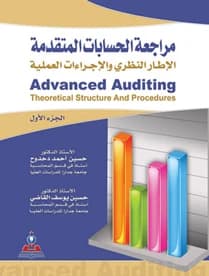
Advanced Auditing 1-2: The Theoretical Framework and Practical Procedures by Prof. Dr. Hussein Al-Qadi
JOD

Get it by 5 Aug | Order in 3 Hours 7 Minutes
- Return Policy
- Warranty Policy
- Shipping Policy
- Non contact delivery
- Personal Receipt
- Return Policy
- Warranty Policy
- Shipping Policy
- Non contact delivery
- Personal Receipt
The emergence of professional auditing in the modern era was a response to the governance needs that arose with the establishment of joint-stock companies following the Industrial Revolution. These companies required large amounts of capital, which they collected from savers in society in exchange for shares corresponding to their participation in the company's capital. These shareholders, often strangers to one another, would convene to elect a board of directors from among themselves—sometimes including external members who were not shareholders—to manage the company on their behalf. This created a need for shareholders to know how their funds were being managed. However, they were unable to directly inspect the company's accounts for technical reasons, as most shareholders lacked the ability to understand accounting information. Time constraints also played a role, as there was not enough time for all shareholders to review the company's records at a specific time. Furthermore, their geographical distribution far from the company's headquarters might prevent them from visiting to review its accounts and ascertain the reality of the accounting information regarding the financial position and operational results recorded in the project's records, which must remain confidential due to the sensitive nature of the information that could pose a risk to the company if it fell into the hands of competitors.
Therefore, it was necessary to have an independent auditor belonging to a profession governed by a code of professional conduct, chief among which is confidentiality. This auditor's adherence to secrecy allows management to disclose its records without fear of competitors, enabling the provision of a professional report to shareholders that demonstrates the credibility of the financial statements published by the management to express the project's economic status at the end of the period. This provides assurance to shareholders about the credibility of the financial statements and the extent to which they reflect the project's situation at a specific moment, including the results of its operations and financial flows during that period.
The importance of the report on financial statements was not limited to shareholders but extended to other parties closely related to the joint-stock company, such as the stock exchange, which is concerned with the trading of shares of these companies. Stock exchanges began to require the adoption of specific principles for accounting measurement and disclosure to accept the listing of a joint-stock company, in order to protect investors and enable them to compare the financial statements of listed companies.
Banks were no less interested in financial statements, given the loans they provide to these companies. What applies to banks also applies to other lenders and bondholders, who are concerned with ensuring the recoverability of their funds by studying the financial statements, which lose their credibility if not examined and audited by an independent and qualified professional firm that provides a neutral technical opinion on the fairness of the company's financial statements, or confirms this fairness.
Thus, the auditor's report gained special importance because it confirms the fairness of the joint-stock company's financial statements and absolves the board of directors of responsibility, or leaves the task of holding the board accountable to the shareholders.
This significant role of auditing, with its impact on investors' decisions, gives these investors the right to sue the auditing firm and claim compensation for any damages they have suffered. The responsibility of auditors may not be limited to the civil aspect but may also extend to criminal liabilities.
Various legislations have also played a role in strengthening the auditor's independence to enable them to express their opinion freely.
- ISBN: 9789957163976
- Weight: 1.400 kg
- Dimensions: 17x24 cm
- Paper: White
- Pages: 704
- Year of Publication: 2012
- Binding: Hardcover







