
Download Our App
Shop your way




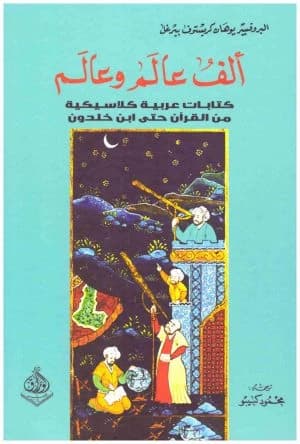
A Thousand Worlds by Johann Christoph Bergel
JOD

Get it by 5 Aug | Order in 5 Hours 12 Minutes
- Return Policy
- Warranty Policy
- Shipping Policy
- Non contact delivery
- Personal Receipt
- Return Policy
- Warranty Policy
- Shipping Policy
- Non contact delivery
- Personal Receipt
The Quran is, according to Islamic belief, the eternal word of God revealed to Prophet Muhammad for Arabs and all Muslims in Arabic – often referred to as an 'Arabic Quran' in the holy book.
This book serves as a guide to newcomers and a literary model for anyone writing in Arabic in the future, reminding us of the past eras, portraying the sacred history of Jews and other ancient religions and civilizations with vibrant clarity.
Arabia during Muhammad's time was not a barren desert devoid of culture but a crossroads of great and ancient religions and cultures. Traces of the Persians, Byzantines, and ancient Arab kingdoms of significant cultural importance are evident.
Notably, the Kingdom of Sheba in the south is mentioned, with its famous queen who conversed with Prophet Solomon, as referenced in both the Torah and the Quran.
In the north, remnants of world-renowned ancient cities during Muhammad's time include Petra (now in Jordan), Palmyra (present-day Syria), and Hatra (currently in Iraq).
Older civilizations like the Assyrian and Babylonian were not completely forgotten.
The foundations for expansive conquests in subsequent decades and centuries were laid, becoming a melting pot of cultures, resulting in great architectural, artistic, scientific, and literary achievements of Islamic peoples.
Muhammad did not solely use force for struggle 'in the way of God' but also established limits to its use, creating practical rules for peaceful coexistence among different peoples. This included not just Muslims but also 'People of the Book,' other monotheistic religions, granting them rights to coexist alongside Muslims.
While it did not signify complete equality, it enabled fruitful cohabitation of diverse cultural followers, a reality still present in Islamic cities today.
Based on the Quran, the oldest surviving literary prose, the essential 'Quranic sciences' originated, aimed at understanding the holy book (the noble Quran), initially comprising historical texts and works on the Arabic language.
Subsequently, linguistic style books were added to demonstrate the eloquence of Quranic style and its inimitability.
In addition to grammar and linguistic style studies, it was necessary to develop the lexicon sciences, culminating in the collection of all Arabic words, exceeding the need to understand the Quran.
These lexicons aimed to comprehend the pre-Islamic difficult Arabic poetry and the Islamic poetry that followed, impressively vast indeed.
A Thousand Worlds







