
Download Our App
Shop your way




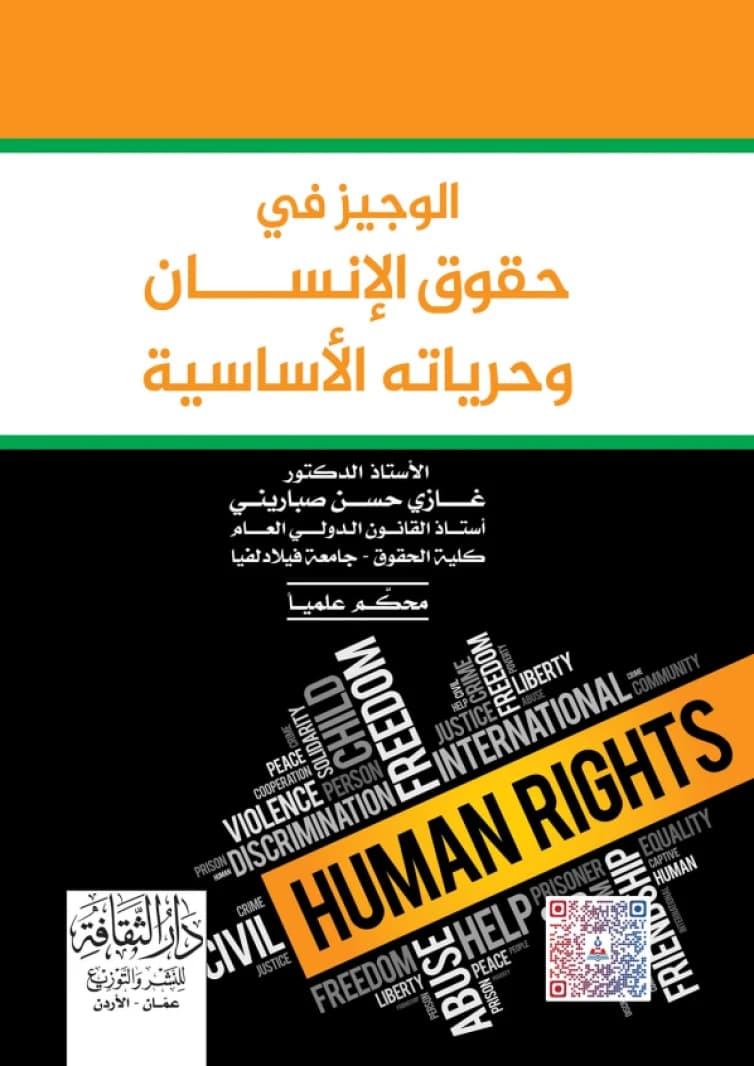
A Summary of Human Rights and Fundamental Freedoms by Prof. Dr. Ghazi Hassan Sabarini
JOD

Get it by 5 Aug | Order in 3 Hours 10 Minutes
- Return Policy
- Warranty Policy
- Shipping Policy
- Non contact delivery
- Personal Receipt
- Return Policy
- Warranty Policy
- Shipping Policy
- Non contact delivery
- Personal Receipt
Praise be to Allah abundantly, and peace and blessings be upon the Prophet upon whom the truth was revealed.
I was entrusted with teaching the subject of human rights at Amman "Al-Ahliyya" University since 1991. It was incumbent upon me to make amendments to my book, 'Human Rights in Positive Law and Islam with Reference to National Legislations,' which was published in Qatar in 1983, so that university students would have sufficient knowledge of the practical reality of events related to human rights, as well as to deepen and enhance awareness of these rights in a manner consistent with Jordanian legislation in this regard.
The theory of human rights is considered one of the most priority topics at the national level, as a result of the concern for justice, the human person, and the establishment of controls to prevent violations against them.
Human rights are also one of the most important topics in the international arena. Hundreds of conferences have been held, and dozens of treaties have been written on the subject. This topic has occupied the minds of jurists and scholars, and they remain engaged with it, their pens active and their opinions divergent, and they still differ.
The need to present human rights as a strategic goal remains, stemming from the community's need to reach a level of integration in its defense and to place it within a model legislative framework.
The intellectual pursuit of the optimal method remains the most effective tool.
The approach followed in the theory of human rights by jurisprudence or legislation has tended to emphasize positive law in rooting these rights.
The need for an academic reference that addresses the theory of human rights from all aspects is my motivation for publishing this book, as contemporary jurisprudence presents the theory within the framework of positive law without addressing Islamic law and its role in establishing these rights.
The reader's need for this book arises from the existing gap in the Arab library. I would like to mention that I have divided the chapters of this book in line with the provisions of the International Covenant on Civil and Political Rights and the International Covenant on Economic, Social and Cultural Rights, both of which were issued in 1966. It is worth noting that the Hashemite Kingdom of Jordan has signed these two covenants and is committed to their provisions, out of respect for international obligations and charters.
Accordingly, I saw that the study of human rights first requires a quick look at the evolution of these rights through different historical stages, human rights in declarations of rights and constitutions, international and regional efforts in this field, and the right of peoples to self-determination. Then I addressed civil and political rights, as they appeared in United Nations documents, which are, to begin with: every human's right to life, liberty, and security of person; the right to be free from slavery and servitude; the right to be free from torture or cruel, inhuman, or degrading treatment or punishment; the right of all people to equality before the law; the right of every person to be free from arbitrary arrest, detention, or exile; the right of every person to a fair and public hearing by an independent and impartial tribunal if accused of a crime; the right of every person to be presumed innocent until proved guilty; the protection of every person's freedom from arbitrary interference with their privacy, family, home, or correspondence; the right of every person to seek asylum in other countries from persecution; the right to a nationality; and the right to marry and found a family.
These rights also include well-known political freedoms such as freedom of opinion and expression, freedom of thought and conscience, freedom of peaceful assembly and association, the right of every person to take part in the government of their country through elections, and the right to equal access to public service.
Then I addressed economic, social, and cultural rights, which include the right of every person to work and to enjoy just and favorable conditions and protection against unemployment. Every man and woman should receive the same pay for the same work. The right of every person to rest and leisure, the right to an adequate standard of living, the right to social security and medical services, the protection and care of motherhood and childhood, the right of every person to education, and the right to participate in the cultural life of the community.
Although these two categories of human rights—civil and political rights, and economic, social, and cultural rights—are dealt with separately for certain purposes, they are interrelated and interdependent. In other words, the full realization of civil and political rights is impossible without the enjoyment of economic, social, and cultural rights. In a third chapter, I addressed the elimination of discrimination and intolerance, as well as racial discrimination.
This is nothing more than a research guide. The sources written in French and English are very numerous, and the works published in Arabic on this subject are proliferating.
I do not say that in this book I have taken another path in research or addressed chapters in which I have expanded more than others, for the book may have flaws that I do not see... and rarely does a person see their own faults.
I ask Allah to grant us success in benefiting from the works of those who preceded us and to guide us in conveying the message to those who follow us. Above every knowledgeable person is one more knowledgeable, and praise be to Allah, Lord of the Worlds.
- ISBN: 9789957166885
- Weight: 0.850 kg
- Size: 17×24 cm
- Paper: White
- Pages: 424
- Year: 2015
- Type: Hardcover







